


Access federal services, visa information, Medicare, Centrelink, and other national support resources in one place.
We collaborate with local and national organizations to deliver practical support for our community. Use the info badge or focus a logo to see how each partner can help.





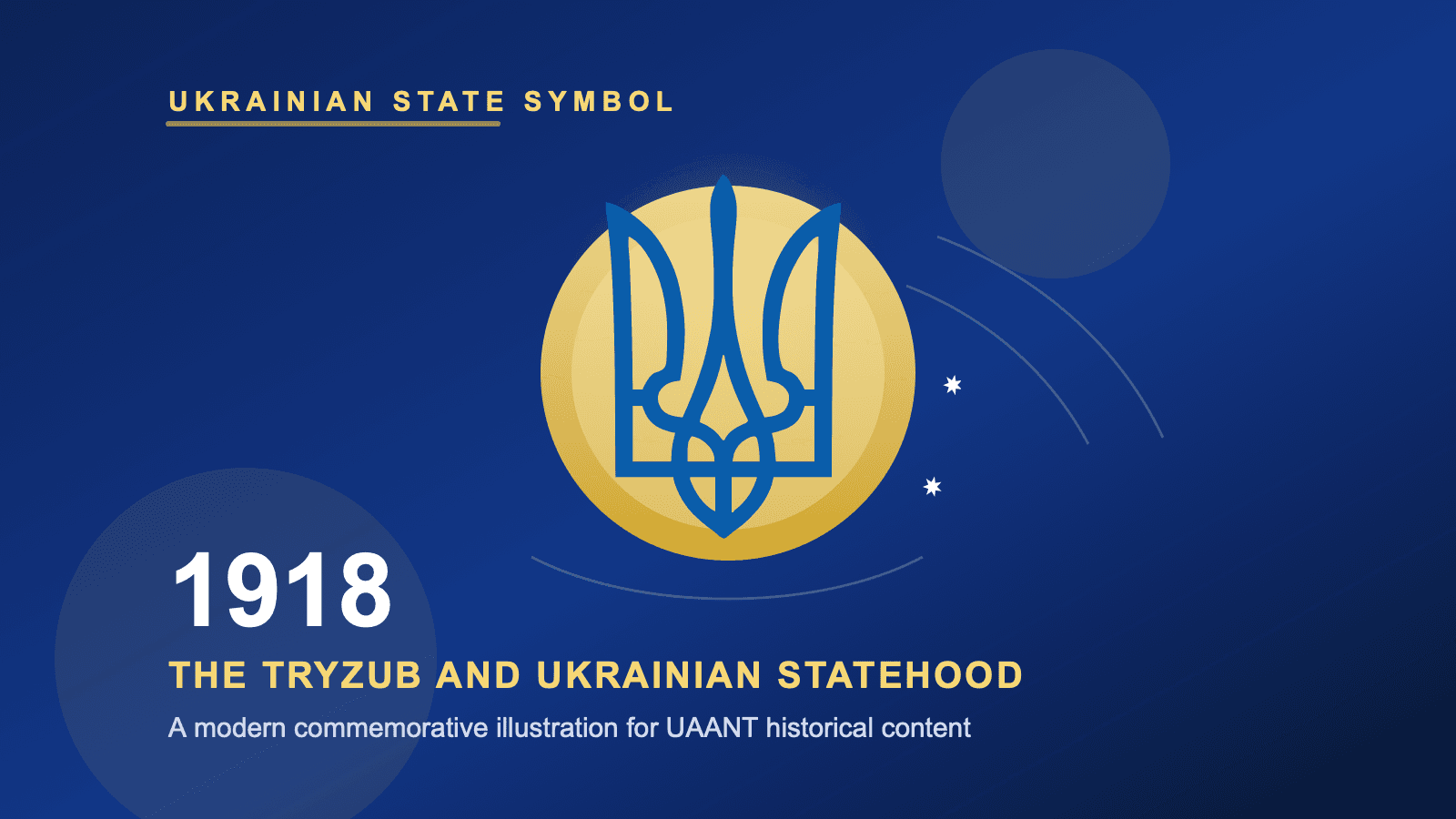
Why the Tryzub became a state symbol in 1918, why it still matters now, and why it remains so meaningful for Ukrainians in Australia.
February 25, 1918 is remembered as a defining moment in Ukrainian statehood: the day the Tryzub became the coat of arms of the Ukrainian People's Republic (UNR). More than a visual emblem, it signaled continuity, legitimacy, and a clear connection between modern Ukraine and its deeper historical roots.
After the collapse of the Russian Empire, Ukrainian leaders needed more than laws and institutions. They also needed state symbols that could communicate legitimacy at a glance. The Tryzub worked because it was already recognizable in Ukrainian historical memory and did not feel like an improvised modern logo.
For the Ukrainian People's Republic, that mattered. A new state had to show both political intent and historical depth. The Tryzub did both.
The symbol is most closely associated with the seals of Volodymyr the Great and the broader heritage of Kyivan Rus'. That made it a strong choice for leaders who wanted to show that Ukrainian statehood had deep roots rather than beginning from zero in the twentieth century.
It also worked well from a nation-building perspective:
There is no single universally accepted interpretation of the Tryzub. Over time, people have read it in different ways, including:
What matters most for readers today is not choosing one perfect interpretation. It is understanding why the symbol endured: it could carry history, faith, identity, and statehood all at once.
The Tryzub outlasted empires, occupations, and attempts to erase Ukrainian identity. That is why it still carries such weight today. It is not only a historical emblem. It is a symbol of:
For many Ukrainians, especially during Russia's ongoing war against Ukraine, the Tryzub represents both memory and defiance.
For Ukrainians in the diaspora, symbols like the Tryzub help hold identity together across distance and generations. They connect families to language, history, and shared memory, even when home is far away.
At UAANT, we keep that connection alive through community events, projects, and practical support for Ukrainians building life in the Northern Territory.
If this story resonates with you, consider supporting UAANT's work to preserve Ukrainian culture, support newcomers, and strengthen our community in the NT.
More stories

Constantinople baptised Rus, founded the Kyiv Metropolis, withdrew Moscow's limited permission and granted autocephaly—the ecclesiastical case without political slogans.
Read story
Why monthly donations help military units plan ahead, how a STRUM subscription works, and why responsible support for Ukraine must continue every day.
Read story
How virtual phone numbers can help people stay connected across countries, including a Ukrainian mobile number used from Australia.
Read story
A practical, lower-risk starting point for Ukrainians in Australia who need current official health-support information.
Read story
A practical starting point for Ukrainians in Darwin who want current CDU fee, scholarship, and admissions information.
Read story
A simple overview of where to start if you need housing-cost support and want the current official Services Australia rules.
Read storySupport UAANT
Every contribution — no matter the size — helps us welcome newcomers, support families, preserve our heritage, and keep the Ukrainian flame burning bright in the Northern Territory.
Direct bank transfer via PayID: uaant.inc@gmail.com · zero fees